

About the Project
Behind every fraud case is a person trying to rebuild their sense of safety, trust, and agency. That was the truth I found at the centre of this engagement — and it shaped everything in how we approached it. The brief was a reporting service modernisation. What I understood it to be was a trust restoration programme for people at one of the most disorienting moments of their lives.
Over a multi-year consultancy engagement, I led the product strategy and design direction and delivery for a national fraud and cybercrime reporting service — shaping its direction from discovery through to delivery, across public-facing and operational systems, for this high-visibility digital program.
The Challenge
The brief presented a broad and ambitious vision; to provide an accessible service for the public and organisations to report fraud and cyber crime, support improved flow of crime, information and intelligence, to disrupt criminals and better protect the public. The discovery process confirmed what I had already understood: this was fundamentally a trust problem. The brief, on the surface, required a reporting and case management tool — but the real design challenge was restoring confidence in a system that had failed to meet people at one of the most disorienting moments of their lives — processing not just the monetary impact of crime, but the trauma of it.
Establishing the Foundations for Transformation
Throughout the discovery phases, in conversations with frontline staff, specialists in crime investigation, victim support and service analysis the same uncomfortable truth continually surfaced: the existing service was designed primarily around the needs of the system, not the person seeking support at their most vulnerable moment. Language was procedural and technical. The experience of being a victim — the shame, the disorientation, the erosion of trust in one's own judgement — was absent in the design.
I proposed that we ground the entire service in a Trauma Informed Design framework — a philosophy that starts from the assumption that every user has likely experienced some degree of trauma, and designs to avoid compounding it. This wasn't in the original brief, and it wasn't immediately an easy sell. TID is well established in clinical and social care contexts; applying it rigorously to a government digital service required making the case to stakeholders who were more comfortable with conversion metrics and technical compliance.
I built the argument iteratively — using our own research, our findings on the psychology of victimisation, service insights and examples from adjacent services — until it became the lens through which every design decision was evaluated. When the TID framework was formally adopted as a foundation for the service, it changed not just the experience of our service but the wider transformation lens. Tone of voice, information architecture, vulnerability assessment, post-submission guidance — all of it was filtered through the question: does this support and restore confidence, or does it ask something of a person who has already given too much?
The Challenge
How might we reimagine the service, to achieve the best possible, positive outcomes for victims, policing teams and the general public when addressing the challenges presented by fraud and cyber crime.
Success Factors
01
Enhanced victim experience
Improve the user experience as victim first/focused to enable an enhanced support and reporting experience to address the impact of fraud and cyber crime.
02
Data quality
Enable better data collection, improve data quality and data analysis to inform prevention and prosecution efforts for fraud and cyber crime.
03
Awareness
Increase awareness of the service ensuring we can serve more citizens and organisations with specific, relevant content.
04
Future proof
Ensuring the service effectively adapts to emergent needs and seamlessly integrates with down stream services.

Product strategy
The Experience Definition Strategy, the key artefact, communicating the rigorous discovery process, evidence based insights, recommendations and human centred thinking underpinning the strategic product vision, outlining the path to realise the future state service.
I lead and crafted the narrative, document and presented the strategic vision to senior project and wider programme stakeholders across the government, securing budgetary approval and commitment to a trauma informed, human centric service vision.

Trauma Informed Design
In response to tackling the core issues of trust and confidence in the system, I championed incorporating a Trauma Informed Design approach, a philosophy grounded in an understanding of how trauma affects behaviour and perceptions, aims to avoid re-traumatisation while promoting healing and resilience. Translating the philosophy for the digital service, while building advocacy across the programme team, the strategy was adopted as the foundation of our approach shaping every product design decision.
Market research and analysis
The impact of Fraud and cyber crime is global, yet the approach to addressing it is disjointed. Exploring relevant crime centric and adjacent services across western markets, highlighted the disparity in approach. This further emphasised the need for a robust and wholistic solution, across the many services we were able to identify patterns and best practices supporting the TID strategy, directly influenced key aspects of the service, including language and tone of voice, accessibility and assistive technology support, branding and more.


Serving human needs
The reality is there is no “typical” victim of fraud and cyber crime, while certain factors may increase risk, anyone can fall fouls of the increasingly sophisticated tactics used by criminal gangs. Working in close collaboration with SMEs across the organisation, I lead analysis of available data from user feedback mechanisms and other sources, to reflect this reality. 12 service archetypes were identified, with 9 developed into expanded personas, to reflect the diverse service users base, inform project and wider programme stakeholders and act as a focal point, ensuring consideration of the complex service, reporting and support needs sit at the heart of strategic decisions.
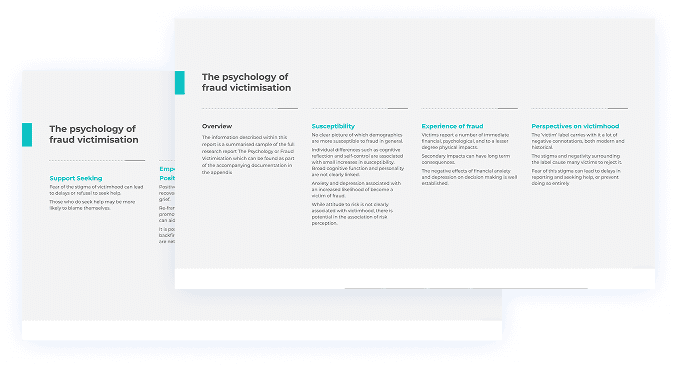
The Psychology of Fraud Victimisation
The impact of Fraud and cyber crime is global, yet the approach to addressing it is disjointed. Exploring relevant crime centric and adjacent services across western markets, highlighted the disparity in approach. This further emphasised the need for a robust and wholistic solution, across the many services we were able to identify patterns and best practices supporting the TID strategy, directly influenced key aspects of the service, including language and tone of voice, accessibility and assistive technology support, branding and more.
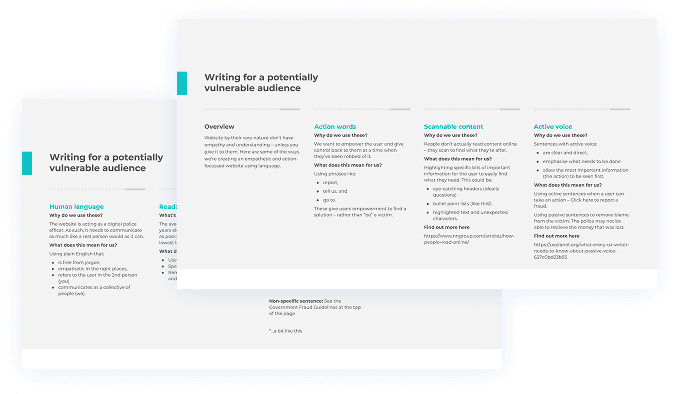
Writing for vulnerability
In England, 18% of adults aged 16 to 65, or 6.6 million people, can be described as having "very poor literacy skills, with the average reading age between 9-11 years old. The invaluable efforts of Toby Cryne, our UX copywriter, shaped the content strategy, establishing tone of voice, incorporating writing best practices and humanised language softening the digital experience to better engage service users, addressing both the literacy challenges, while aligning to the TID strategy.
A set of tailored guidelines tailored covering news, guidance and support articles empowered the services’ communications teams to adopt the strategy.
The Journey to Impact
Spanning multiple work streams, back-end operational and front-end public facing solutions, over a multi-year engagement, the path to realising a Trauma Informed vision for the service required me, and my team to move between research, ideation and delivery, incorporating new information and changing requirements into the product strategy, maintaining a shared understanding in parallel with the product delivery streams.
A major focus centred on ensuring alignment across a wide set of invested stakeholders, finding the right balance between the operational needs and dependencies without compromising service users needs for reporting, guidance and support. I partnered closely with the engineering team – actively seeking input and feedback on designs, addressing technical constraints, reviewing and approving all implementation throughout sprint cycles – to ensure the intent and quality came through in implementation.
As the breadth and depth of my involvement expanded, beyond the core scope of the service delivery, the product owners leveraged my intimate knowledge – across both the customer facing and back-end operational service solution – presenting the strategy and solution directly to ministers and government departments, advocating for the TID approach, addressing questions and concerns raised around program objectives, scope and adaptability. These presentations and the relationships developed proved critical in maintaining confidence and commitment, across multiple stage gates and budget approvals.
Report Triage
Operationally the reporting journey represents the primary use case for the service, however users’ frequent feedback highlighted a deep sense of frustration and anxiety at the complex, opaque and often confusing (yet crucial) process. Crime reports play a key role in efforts to understand fraud and cyber crime – informing threat profiles alongside prevention and disruption initiatives. The legacy service suffered a high volume (largest %) of generic reports, alongside miss classified reports, impacting data quality, intelligence and investigation metrics.
The upfront ‘triage’ is the top of the reporting funnel and determines the report type and question set presented in the reporting form, so addressing friction and optimising this journey represents a key opportunity to improve the service, not least as time lapsed, between incident and report is a highly critical factor affecting outcomes, and can mean the difference between a positive resolution or frustrated victim of crime.
The solution needed to address the core needs of both users and service operators
Service users
Confidence in making the right type of report: crime or information
Accurate identification of the specific crime type experienced
Clarity around the service, reporting process and timelines
Operations
Improved self-service management of the Triage and reporting experience
Increased ability to respond to changes in crime trends rapidly (i.e. Covid, crypto etc.)
Enhanced flexibility of the system to tailor a journey based on reporters context
Given a reports direct impact across all objective metrics, I dedicated time to unpack major friction points at the top of the funnel–leveraging user feedback and journey mapping to understand the complexity behind the scenes, supported by Elliot, our research specialist. I developed two strong candidates to address the major points of friction, incorporating TID principles to enhance visibility, agency and clarity, to increase users confidence in their choices.
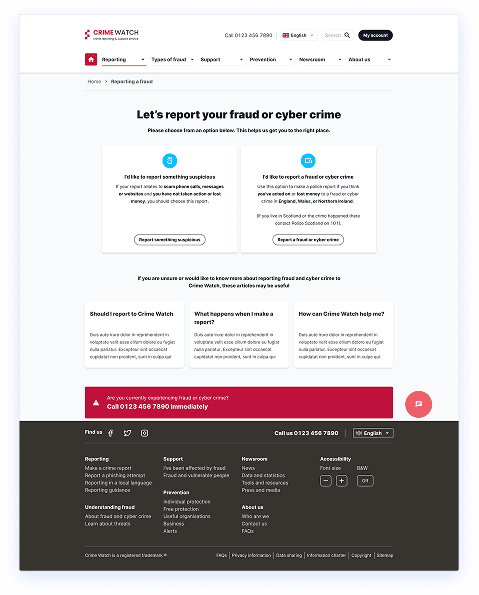
I had a strong conviction going into the triage design: that a sentence-based, conversational structure — Option A — was the right approach. It felt more human, more aligned to the TID framework, closer to the natural way a person would describe what had happened to them.
Testing proved me wrong. Participants found it more natural in tone — but the lack of structured crime type categorisation, available but not inline, left them uncertain. The humane framing I'd prioritised had created its own form of friction.
Rather than defaulting to Option B, I used that finding as an opportunity. If Option A's strength was conversational warmth and Option B's was structural clarity, the question became whether we could build something that didn't trade one for the other. The third solution — a card-based flow with embedded conversational language, and clarity — addressed what both earlier versions had separately missed. It outperformed both in accuracy and in the experience of participants whose experience with the original service had left a deep sense of frustration and anxiety.



Completing a Report
The report form presented its own set of challenges, primary amongst them the significant effort across a multi steps journey, alongside the need for the individual to share extensive details and personal information in order to effectively support an investigation. Already in a fragile state of mind, this lead to heightened anxiety and friction, at the very moment when trust is already impacted due to the experience of crime. We sought to address a targeted set of barriers to effective reporting:
Service users
Improve transparency around the reporting process, and how information is handled.
Support informed choice, confidence and trust around disclosure of information.
Simplify data entry to speed up reporting.
Sufficient support for all users, access needs and literacy to create a crime report.
Empower affected individuals to take pro-active action in response to the crime
Operations
Enhance the ability to manage, maintain and tailor reports to a users circumstances.
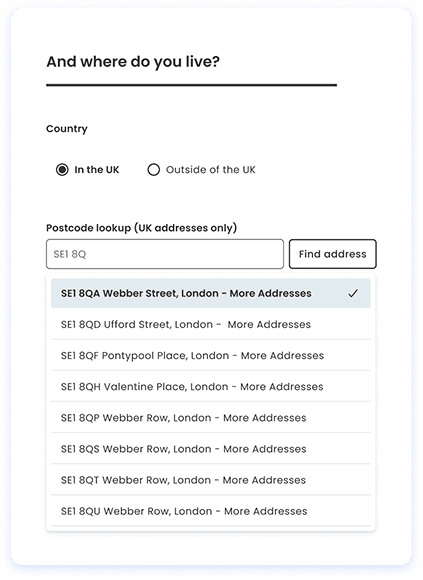
Modernise form capabilities with core enhancements to simplify data reporting (i.e. address lookup, payment information, bulk reporting etc).
Effectiveness identifying vulnerable users and providing effective support.
Provide tailored, relevant support and guidance based on report context.
The dynamic nature of fraud and cyber crime requires an equally dynamic solution to effectively support reporting, while staying in step with the emerging threat profile of this prolific crime – a lesson learned the hard way following the outbreak of Corona Virus, placing unprecedented demand on the organisations ability to respond effectively.
To directly address the operational pain points – hard coded questions and logic, inflexible configuration with limited adaptability – I designed and secured buy in for a flexible, dynamic reporting solution, fully manageable through the CMS, capable of supporting complex, down-stream system dependencies post capture and dissemination.
On the front end, enhancements such as the report stepper, dynamic context frame, data entry accelerators and more help reduce cognitive load, sped up data entry and increased data quality. I devised several strategies to further reduce friction and prevent abandonment; Reducing error scenarios through clear and inclusive copy, limiting mandatory fields, and applying front end regex validations, providing appropriate guidance and enforcing specific data requirements without preventing progression.
While these steps might appear counterintuitive there was sound reasoning behind the approach, firstly error messaging, regardless of copy, implies the user is at fault – a particularly sensitive scenario for the service – while allowing for users to exercise their preference around data disclosure supports report progress, promotes self-efficacy and agency, reducing the potential of abandonment.
To address stakeholders concerns relating to data quality, the review step took on a dual role, a playback of the reporters information, while performing a pre analysis of the data, highlighting the highest value data points which contribute to the investigation and intelligence picture. These tiered inline notes – from optional/helpful to important – allow service operators to provide targeted nudges prior to submission, guiding the reporter where possible to consider sharing additional information, mirroring a report made to an investigator or support agent.
Combined, these enhancements smoothed out many of the legacy friction points, while post submission, tailored guidance to the specific crime context delivered instant, relevant support in managing the impact of crime and prevention of repeat victimisation.

Enhanced report routing and reporting guidance increase transparency to better manage expectations (Wireframe)
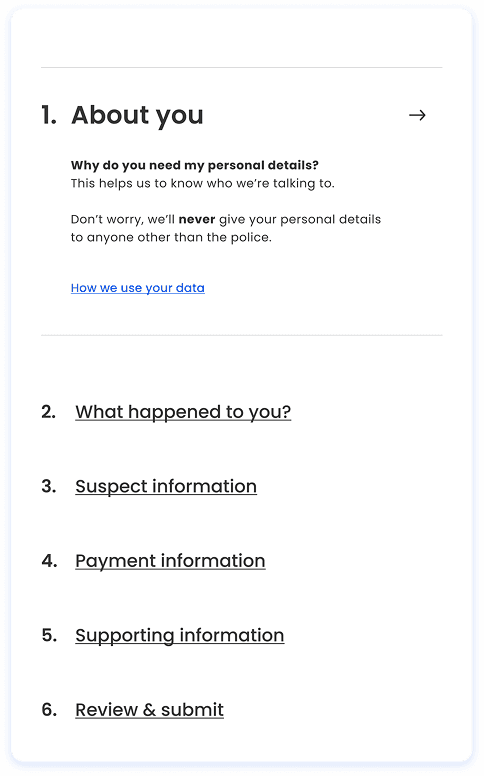
Enhanced report routing and reporting guidance increase transparency to better manage expectations (Wireframe)

Enhanced report routing and reporting guidance increase transparency to better manage expectations (Wireframe)

Enhanced report routing and reporting guidance increase transparency to better manage expectations (Wireframe)

Enhanced report routing and reporting guidance increase transparency to better manage expectations (Wireframe)
Enhanced report routing and reporting guidance increase transparency to better manage expectations (Wireframe)
Supporting ‘at risk’ Individuals
The identification of at risk individuals, through user interactions with the service, is core to ensuring all vulnerable individuals are effectively identified and appropriately supported, regardless of the interaction touchpoint. The current assessment suffered from a poor user experience, with limited capacity to offer real support during the reporting journey.
Given the nature of the crimes reported through the service, our default position is to anticipate individuals have likely suffered trauma – from mild to severe – due to the impact of a fraud or cyber crime or as a result of external factors, further impacting their ability to cope with the affects of the crime. I approached the challenge with some key considerations.
Service users
The new assessment must not cause (or seek to minimise) the individual feeling increased distress, stress or lead to re-traumatisation.
The individual must remain in control of the process and have the freedom to end the engagement at any point without judgement
The assessment questions support a rounded (or wholistic) understanding of the individuals personal situation, current mental state, health and wellbeing.
Operations
The assessment is designed to leverage a Trauma Informed Design framework.
The service has a ‘duty of care’ to ensure at risk individuals are effectively identified and receive the appropriate level of support.
It must be possible, based on context, to omit or ask further questions relating to the answer(s) provided. Similar to mimicking an support agent interaction.
It must be possible to fine tune or iterate the assessment flow to improve outcomes.
I lead the vulnerability work stream, fostering deep collaboration between my team and working groups comprising specialists focused on Vulnerability and Re-victimisation, forensic linguistics and partners who support victims of crime, to understand the complex nature of vulnerability and explore the best to approach to tackling this deeply personal and nuanced challenge, best achieved through human-to-human interaction, via a self-service modality.
The primary challenge I had to overcome was not a lack of information or knowledge, but the balance between the genuine desire to deeply understand the individual and provide effective support, with the potential for resistance from vulnerable users who would most benefit. Over many co-working sessions, I drove the discussions, taking on board the broad set of perspectives, challenges and constraints, aiming to find a balance between the benefits and against potential downsides.
Working in close collaboration with Elliot, through multiple iterations the themes, question sets, assessment flow and vulnerability rating came into focus. To address the primary issues with engagement, the assessment leveraged context from the main reporting journey, only triggering based on configurable soft signal answers to leverage the reporters stated context. In addition, the modal presented provided clear context, guidance and agency, allowing for individuals to make an informed choice to proceed based on the benefit of engagement, taking care not to apply undue pressure. Furthermore, the assessment supported branching, allowing for follow up questions to be presented or skipped, based on the answers provided, mirroring the natural human experience. Lastly upon completion of the assessment, based on the accumulative weighted risk profile, tailored guidance–ranging from recommended next actions to direct intervention allowed for the best support outcome to be realised.
Internal testing across the working group validated the solution, receiving high praise, with one senior stakeholder stating it “a step change for how we support at risk service users”. The ability to assess and support vulnerable users, while providing flexibility to manage every aspect of the assessment led to elements being adopted by the telephone support team conducting human-to-human assessments.


Outcomes & Impact
Noting NDA constraints on specific performance metrics, the following reflects the outcomes of the programme to date:
The Trauma Informed Design framework, initially proposed and championed through discovery, was formally adopted as a programme-wide foundation — influencing decisions across tone of voice, content strategy, vulnerability assessment design, and post-submission support architecture.
The vulnerability assessment solution received strong validation across internal working groups and stakeholder review. Its approach to contextual intervention — triggering only on configurable signals, preserving user agency throughout — was subsequently adopted by the telephone support team for human-to-human assessments, extending the model beyond the digital service.
The Experience Definition Strategy — presenting the evidence-based case for a trauma-informed, human-centred vision — secured programme-level budget approval and executive sponsorship across multiple government stage gates.
Due to NDA hard metrics for the engagement are restricted, however since launch available data shows reporting volume increased by 80% - 127% (year-on-year equivalent volumes), while generic reports no longer rank in the top 5 of reported crime categories.
The service architecture and philosophical foundation laid during this engagement positioned the programme for the next generation of capability — several concepts designed but technically out of reach at the time (conversational triage, sentiment-based vulnerability detection, unstructured data reporting) are now realisable with current generative AI capabilities.
Report Triage
Operationally the reporting journey represents the primary use case for the service, however users’ frequent feedback highlighted a deep sense of frustration and anxiety at the complex, opaque and often confusing (yet crucial) process. Crime reports play a key role in efforts to understand fraud and cyber crime – informing threat profiles alongside prevention and disruption initiatives. The legacy service suffered a high volume (largest %) of generic reports, alongside miss classified reports, impacting data quality, intelligence and investigation metrics.
The upfront ‘triage’ is the top of the reporting funnel and determines the report type and question set presented in the reporting form, so addressing friction and optimising this journey represents a key opportunity to improve the service, not least as time lapsed, between incident and report is a highly critical factor affecting outcomes, and can mean the difference between a positive resolution or frustrated victim of crime.
The solution needed to address the core needs of both users and service operators
Service users
Confidence in making the right type of report: crime or information
Accurate identification of the specific crime type experienced
Clarity around the service, reporting process and timelines
Operations
Improved self-service management of the Triage and reporting experience
Increased ability to respond to changes in crime trends rapidly (i.e. Covid, crypto etc.)
Enhanced flexibility of the system to tailor a journey based on reporters context
Given a reports direct impact across all objective metrics, I dedicated time to unpack major friction points at the top of the funnel–leveraging user feedback and journey mapping to understand the complexity behind the scenes, supported by Elliot, our research specialist. I developed two strong candidates to address the major points of friction, incorporating TID principles to enhance visibility, agency and clarity, to increase users confidence in their choices.
I had a strong conviction going into the triage design: that a sentence-based, conversational structure — Option A — was the right approach. It felt more human, more aligned to the TID framework, closer to the natural way a person would describe what had happened to them.
Testing proved me wrong. Participants found it more natural in tone — but the lack of structured crime type categorisation, available but not inline, left them uncertain. The humane framing I'd prioritised had created its own form of friction.
Rather than defaulting to Option B, I used that finding as an opportunity. If Option A's strength was conversational warmth and Option B's was structural clarity, the question became whether we could build something that didn't trade one for the other. The third solution — a card-based flow with embedded conversational language, and clarity — addressed what both earlier versions had separately missed. It outperformed both in accuracy and in the experience of participants whose experience with the original service had left a deep sense of frustration and anxiety.
Home for all
Service signalling
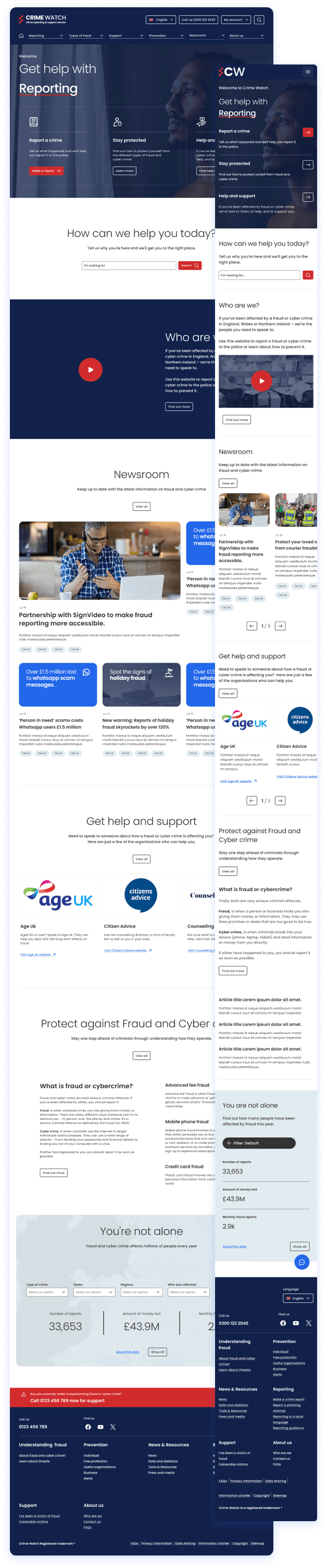
From first interaction the purposed of the service is clear – Report, learn about and get support with fraud and cyber crime – reinforced through prominent call to actions for engaging with, and benefitting from the service.
Move from need to knowledge
In moments of distress our human instinct is to ask for help, leveraging improved capabilities in search the gap from need to support is flattened.
Transparency and humanity
Communicating the purpose and impact of the service with clarity – through video, copy and content – builds empathy, trust and a desire to ‘play your part’ in tackling the issue.
The first line of defence
The threat of fraud and cybercrime is constantly evolving, trends and know spikes in certain offences – seasonal events like tax return deadlines align with increased HMRC scams – leverage high stress, time pressured events to deceive victims. intelligence based, proactive communication around prevalent threats help raise awareness, support information seeking behaviours and protect advice initiatives.
Tackling stigma of seeking help and support
Assisting visitors to access the support and services best placed to help manage the impacts of crime by elevating the services to first class citizens in a holistic service model. Ease of access helps reduce avoidance or delays in seeking help and accessing support, while reducing the felt by many.
Protection starts with education
The reality is, the general public has very limited knowledge or hold false narratives regarding the threat and types of fraud and cyber crime. Surfacing relevant content directly on the home page, leveraging non-technical language, supports education while encouraging self service support journeys.
Furthermore, leveraging data to curate and prioritising guidance, based on volume, seasonal trends or other factors enhances the impact of protect and prevention initiatives.
Reducing self blame and isolation
Key insights into victimisation highlight the negative associations and stigma of ‘being a victim’ which can lead to avoidance or delays in seeking help or reporting a crime. Transparency on the impact of fraud and cyber crime helps raise awareness, supports prevention initiatives and encourage reporting while tackling common affects; the behaviour of self-blame, associated stigma and sense of isolation.

Reporting with confidence
Making the right report
Pre-report guidance helps ensure users are directed to the right service for their specific needs. Making a full crime report or performing a civic duty by reporting suspicious activities have significantly different data requirements. Supporting high volume, high frequency non crime reporting enhances intelligence gathering, while crime reporting guidance supports effective reporting, addressing motivation to report alongside prevention initiatives.
Transparency and agency
A lack of clarity and feedback about the reporting process adversely affected users motivation and confidence in reporting through the service. Addressing this head on with clear signposting and transparent communication – around the reporting process, investigation timelines and potential outcomes – helps improve clarity, reduce anxiety and support self service while reducing inbound call volume into the contact centre, freeing agents to focus on crime reporting and at risk support use cases.
Identifying the crime
Simplify selection to improve accuracy
Reimagining the triage experience from a ‘test of the individual’ into a conversational approach, mirroring the natural human to human reporting behaviour, reduces complexity to more effectively guide service users to the identify the appropriate report type with confidence, supporting data quality objectives.
Flexible and supportive
The ability to review selections and easily adjust answers helps to increase comfort and reduce anxiety, while allowing for identification of information (non crime) reports to be redirected without friction, reducing unnecessary data requirements, supporting effective reporting, aligned providing an enhanced victim experience.


human friendly reporting
Tailored to context
Reimagining the triage experience from a ‘test of the individual’ into a conversational approach, mirroring the natural human to human reporting behaviour, reduces complexity to more effectively guide service users to the identify the appropriate report type with confidence, supporting data quality objectives.
Agency, transparency and context
Improved transparency and guidance regarding data use and requirements for reporting build trust and comfort, promoting richer report context and information sharing aiding investigations and intelligence efforts.
Focus and clarity
Reducing friction and cognitive load helps to avoid overwhelming reporters leveraging question theming and focus frames coupled with inclusive humanised language reduce anxiety. Accelerators – pre population (for registered users), data informed defaults, such as country codes, currency and address lookup further simplify data entry, saving time while enhancing data quality and accuracy.
Supporting those at risk
Vulnerability aware
Supporting intelligent identification of at risk individuals trough contextual signals helps support ‘intervention’ where it’s needed most. To promote participation, the choice of language and clear communication of benefits encourage engagement while respecting agency.
Personalised, conversational and actionable
The assessment promotes a holistic understanding of an individuals needs and covers multiple themes –including mental health, victimhood, disabilities, prevention, financial impact, support and experience of crime – presented in a humanised, conversational tone as multiple choice answers which support branching to ensure the users context informs the assessment and support needs.
These characteristics allow for effective triage, supporting next best action recommendations, from resources and signposting of appropriate help and support services to the need for direct intervention and support in more extreme scenarios.


Improving data quality
Behavioural nudges
During reporting the use of mandatory fields are minimised, with errors presented without blocking progression to both encourage completion and reduce friction, which might otherwise lead to abandonment.
Pre-submission an automated review highlights missing key information which support investigation needs. Leveraging a traffic light system of targeted nudge messages offering guidance on mandatory and non mandatory questions to support informed decisions on data sharing and encourage more comprehensive reporting – driving enhanced data quality and intelligence – benefitting the individual and policing services address the crime.
Tackling the impact of crime
Proactive, tailored information and guidance
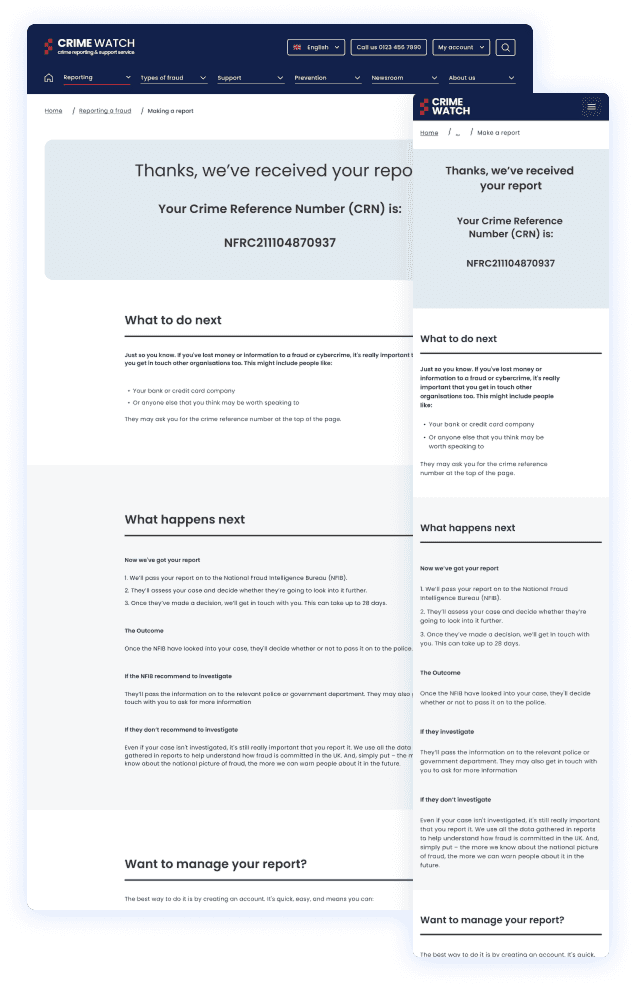
Post submission information including crime reference number, reporting process, timelines and possible outcomes, alongside managing the report and general support available via the service provide proactive guidance for effective self service. In addition, characteristics captured during the triage and report allow the provision of tailored guidance to the specific circumstances – including tools, resources and signposting to help and support services – allowing victims to rebuild confidence, reduce the risk of re-victimisation and manage important actions beyond the service.

Education to impact
Raising awareness
Prevention is the best form of defence with fraud and cyber crime. While knowledge is powerful, it only becomes impactful if it’s easily understood, with clear, tangible actions individuals can leverage to guard against targeting or respond effectively if impacted.
Addressing literacy, language, content formats and more to address psychological factors such as shame, culpability and disempowerment while reframing fraud and cyber crime as the complex and sophisticated criminal enterprise it, supporting service operators create appropriate content that’s clear, impactful, and actionable.
Accessible for all
Sensitive, supportive and accessible
In addition to managing the impact of the crime itself, service users can also face significant challenges to make a report. From the earliest conversations meeting users where they are, supporting access needs – assistive technologies, alt tag labelling, keyboard navigation and zoom levels – throughout the service, ensures every user has access to the full service benefits.
For the most vulnerable service users coping with sensitive, dangerous or challenging personal circumstances, additional support is needed to make reporting possible – the emergency exit button, pinned to the page and accessible via a keyboard shortcut – instantly hides the service, launching new browser tabs and loading system defined URLs to help reduce suspicion for users who may be in a compromised position.

Reflections
This project tested every dimension of my design leadership. The technical complexity, the political sensitivity, the emotional weight of the subject matter, the multi-year duration — all of it demanded something beyond craft or strategy. It required me to hold conviction about the human experience at the centre of the service, even when the programme's gravitational pull was toward operational efficiency and technical compliance.
What I didn’t fully anticipate was how vulnerable a deeply considered solution can be to structural changes above the design team’s authority. Late in the programme, a technology partner change at programme level meant the in-house development team and I lost direct control over implementation of the final reporting form. The simplified version that shipped retains the TID principles in tone, content strategy and vulnerability assessment — but some of the more considered interaction design decisions were lost in the transition. The outcome metrics reflect a genuinely improved service; they also reflect a version of the vision, not the whole of it.
That experience taught me something I’ve carried forward: embedding a design philosophy deeply enough that it survives changes in who implements it requires more than stakeholder alignment on the vision. It requires documented design rationale at the decision level — not just what was built, but why each element exists and what it costs to simplify it. Had I built that layer earlier and more formally, the principles may have been harder to deprioritise when delivery pressures arrived. It’s the lesson I’d apply from day one on any programme where I don’t own implementation end-to-end.
Several concepts designed during this engagement — the conversational triage, intelligent pre-population, sentiment-based vulnerability detection, reporting with freeform unstructured data — were technically or commercially out of reach at the time. With the emergence of generative AI, they aren’t anymore. The work laid a philosophical and structural foundation that the next generation of this service is well-positioned to build on. That, perhaps more than any single feature, is what I’m most proud of.
